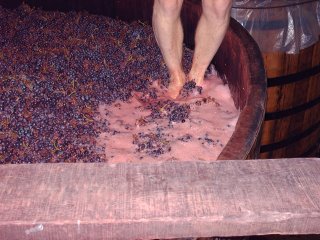
Last night our managing director was entertaining a business partner in the restaurant. That means that I get to dust off some rather special bottles to impress our guests and show off a little bit. Now usually what I would do is spend a little while down in the cellar poking around to come up with a few ideas to show. Often I wont have an idea of what they are eating until they have chosen the menu, so I like to have a few options available so that when they chose their meals I am somewhat prepared.
I always chose a nice champagne to start off with. As we are aiming to impress a bit, I chose a prestige cuvee, the Clos de Goisses from Philipponnat, 1990. Clos de Goisses was the first single vineyard champagne and remains one of the most elusive and exclusive champagnes on the market. The vineyard is on the south facing slopes on the banks of the river on the outskirts of Mareuil-sur-Ay. Dominated by Pinot Noir this wine was disgorged in April 2000, meaning it spend about 9 years on the lees, giving it rich autolytic flavours. A wine that truly benefits from a decent bit of bottle aging.
Now the starters are usually always fishy in character so here I steered towards a New Zealand Savvy, this one came from Central Otago from a winery called Mount Difficulty. Central Otago is the most southerly commercial winegrowing region in the world. Located in the centre of the South Island it enjoys a continental climate, so the longer ripening season allows the grapes to reach superb levels of ripeness. The region is especially suited to Pinot Noir, but Sauvignon, Pinot Gris and some riesling is also produced here. The wine has a vibrant nose of tropical fruits typical of a Kiwi savvy, but with undertones of green peppers, gooseberries and other herbaceous characteristics. Fantastic wine!!
For the main course, as the meals chosen were Squab and Ellel Chicken I opted for a burgundy with a bit of bottle age on it, a 1988 Vosne Romanee "Aux Reas" from Anne Gros. As I pulled the cork on it, my nose was assaulted by the pungent aroma of TCA. The cork was humming!! Now Ive had bottles where the cork reeked of TCA, but the wine has been clear and untainted, and vice versa. So with some trepidation I poured a small sample into a glass and swirled and sniffed. Damn! It was foul. So I turn to my backup bottle and peel the foil, insert my screwpull and extract the cork. It wasnt as strong, but this cork reeked too. Bottle number two also proved to be corked, but not to the same extent, and given five minutes to breathe off, could almost have passed as servable. But I dont like to serve sub-standard wine, so I re-cork it, and consign it to the kitchen where it will end up in the stock. Im gutted. I was really looking forward to trying the wine and that was my last two bottles. Plan A exhausted I have to fall back on plan b, a slightly hazy bottle of Meo-Cazumet Nuits St Georges 1er Cru "aux Mergers" 1996. A much younger wine and a fine suspension of sediment, that my less than gentle journey from the cellar had disturbed. But wow, amazingly vibrant fruit flavours, with an earthy afterpunch. It took a little while to really settle down, and unfortunately there was a fine suspension of sediment making the wine slightly cloudy and opaque, but personally I dont mind that. Meo-Cazumet bottles their wines unfiltered and unfined, so I suppose a small amount of suspended sediment is inevitable.
So at the end of the day, the meal was enjoyed, the wines went down a treat, but Im still gutted about the Vosne-Romanee. Damn that TCA.
Thursday, June 29, 2006

Saturday, June 24, 2006
Me and my commis
So Danny started working as my commis this week, and he's got off to a fairly good start so far. I gave him some homework last week to find out four facts about six different champagnes that I gave him. Now he had to do a fair bit of digging to get some of the information, but he rose to the challenge and came up with the information and even surpassed some of my expectations. Added to which he has been pestering me for more information and seems to be constantly questioning things which is annoying sometimes, but its also good, because he's keen and he really wants to learn.
So now I need to go and set him some more homework for this weekend.
So now I need to go and set him some more homework for this weekend.
NYE part two
Well it serves me right for getting ahead of myself, but the wines that I posted on my last post havent exactly been given the green light yet. If fact Im now on draft three (four if you count a piss-take effort), but the good news is that the wines are getting a step higher in terms of quality and appeal. I ought to have known better that the first draft wouldnt get greenlighted, but I guess I wasnt thinking straight.
So now what are we looking at? Well subject to approval we plan to start the evening off with magnums of Bollinger Grand Annee (vintage tbc). Ross rightly felt that we weren't starting the evening off with a big enough bang, and he wanted a more recognisable product that the customer could latch on to. The meursault and eden valley riesling have remained on the list so far, so I cant really see them changing much. For the main course I'm planning on a rather special wine - Mouton Rothschild 1994 in Double magnums. This is obviously subject to us laying our hands on sufficient numbers of bottles to actually do it, but what a stonking selection for the main course eh? For the cheese we are looking a putting in a Larrivet Haut-Brion Blanc 1995. Then for pudding an Imperial of Chateau Guiraud sauternes. Ross is currently contemplating the costings and we will have a few tweakings here and there to reach the final agreement, but I think we are close.
So now what are we looking at? Well subject to approval we plan to start the evening off with magnums of Bollinger Grand Annee (vintage tbc). Ross rightly felt that we weren't starting the evening off with a big enough bang, and he wanted a more recognisable product that the customer could latch on to. The meursault and eden valley riesling have remained on the list so far, so I cant really see them changing much. For the main course I'm planning on a rather special wine - Mouton Rothschild 1994 in Double magnums. This is obviously subject to us laying our hands on sufficient numbers of bottles to actually do it, but what a stonking selection for the main course eh? For the cheese we are looking a putting in a Larrivet Haut-Brion Blanc 1995. Then for pudding an Imperial of Chateau Guiraud sauternes. Ross is currently contemplating the costings and we will have a few tweakings here and there to reach the final agreement, but I think we are close.
Wednesday, June 21, 2006
Happy New Year!!
You might think that Im being a bit forward here, but tonight Ive been planning the wines that we will serve on New Years eve here in the hotel. Just over five months away and here I sit matching up wines to a menu that Chef came up with a couple of weeks ago. I was slightly surprised to hear we've had over a dozen enquiries about the festive package already, but I guess after nearly 15 years working in the trade I ought to know better by now.
At this stage all Im working out is a costing for the wines to go with each course. I have a spreadsheet (God bless excell!!) that works out the cost prices plus VAT, divided into portions, and then it gives me a total cost per person based on a higher than average consumption. By over calculating, I can make sure that we work out the worst case cost and track back from there. Once I'm happy with my choices, they get passed on to Andre the F&B manager to give his approval, before getting signed off by Ross. It's all about getting the right balance of choice, value and quality, because the guests are paying a lot of money to have their celebrations here, and we want to make sure that the package we offer is good value.
So what kind of wines are we looking at?
Guests will arrive and start the evening off with a glass or two of Aubry's Nombre d'Or champagne. This is an unusual champagne in that it is made from the conventional three champagne grapes (Chardonnay, Pinot Noir and Meunier) with the addition of three traditional grapes (Arbanne, Pinot Gris and Petit Meslier). The last three are old grapes that have mostly been forgotten and uprooted within the region. L. Aubry fils are one of a handful of producers that still use these grapes, their arguement being that if they were used in the olden days there must have been a reason for it. The champagne has quite a floral nose, dominated by Pinot Gris (30%), with citrus and a fruity almost grainy flavour from the Meunier (15%). An interesting start to the evening.
For the first course the wine we are planning to serve is a Meursault from Domaine Roulot, 1999 "les Chaveux" Meursault. Another fairly aromatic wine, with that lovely perfumed character that I find in Meursault. It should complement the mosaic of french partridge with jellied figs and scottish lobster quite well.
For the second course, we travel down to the Eden Valley of South Australia for a riesling from a co-operative of well known Barossa winemakers and growers. The Saviours as they have dubbed themselves are comprised of some serious big names in the region - Stephen Henschke, James Irvine, Bob Berton, Peter Seppelt, and Joanne Irvine are some of the more prominent. Selected from parcels of fruit from the twelve members vineyards, and vinified under the guidance of Stephen Henschke and the Irvines, this riesling is a fantastic example of New World riesling, crisp bright citrus flavours, with a floral, rose petal elegance on the nose. Intensely fruity on the palate with crisp acidity and a lingering minerality on the finish.
We bring out one of the big guns for the main course with a 1996 La Mission Haut-Brion from Pessac-Leognan. Huge dense black fruits on the nose with a deep cedarwood and mineral undertone, this is a serious wine. Second only to Haut-Brion in the region this stellar wine has produced consistantly good wines even in challenging vintages.
The one quirk of the evening comes with the cheese course. For the crispy goats chees with winter truffle salad I'm planning on serving a Rashiku Junmai Sake. Coming from the Yamatagowa brewery in the prefecture of Fukushima, this is produced from Hanafubuki organic rice that is milled to 58% of the grain. This means that the outer 42% of the grain is polished off, leaving the purer starches to ferment. Served lightly chilled this sake has similar flavour characteristics to a sauvignon blanc which makes it an interesting complement for the goats cheese.
Finally for the dessert I'm planning on serving a Jurancon moelleux from Clos Guiroiulh. Made from Petit Manseng and Gros Manseng grapes, this wine has a richly unctuous honeyed flavour with a grapey, slightly floral nose. It should be a nice match for the mandarin and white chocolate glace souffle.
So thats about the gist of what people can expect for New Years eve in the Arkle. Now to start planning for the Westminster Suite.
At this stage all Im working out is a costing for the wines to go with each course. I have a spreadsheet (God bless excell!!) that works out the cost prices plus VAT, divided into portions, and then it gives me a total cost per person based on a higher than average consumption. By over calculating, I can make sure that we work out the worst case cost and track back from there. Once I'm happy with my choices, they get passed on to Andre the F&B manager to give his approval, before getting signed off by Ross. It's all about getting the right balance of choice, value and quality, because the guests are paying a lot of money to have their celebrations here, and we want to make sure that the package we offer is good value.
So what kind of wines are we looking at?
Guests will arrive and start the evening off with a glass or two of Aubry's Nombre d'Or champagne. This is an unusual champagne in that it is made from the conventional three champagne grapes (Chardonnay, Pinot Noir and Meunier) with the addition of three traditional grapes (Arbanne, Pinot Gris and Petit Meslier). The last three are old grapes that have mostly been forgotten and uprooted within the region. L. Aubry fils are one of a handful of producers that still use these grapes, their arguement being that if they were used in the olden days there must have been a reason for it. The champagne has quite a floral nose, dominated by Pinot Gris (30%), with citrus and a fruity almost grainy flavour from the Meunier (15%). An interesting start to the evening.
For the first course the wine we are planning to serve is a Meursault from Domaine Roulot, 1999 "les Chaveux" Meursault. Another fairly aromatic wine, with that lovely perfumed character that I find in Meursault. It should complement the mosaic of french partridge with jellied figs and scottish lobster quite well.
For the second course, we travel down to the Eden Valley of South Australia for a riesling from a co-operative of well known Barossa winemakers and growers. The Saviours as they have dubbed themselves are comprised of some serious big names in the region - Stephen Henschke, James Irvine, Bob Berton, Peter Seppelt, and Joanne Irvine are some of the more prominent. Selected from parcels of fruit from the twelve members vineyards, and vinified under the guidance of Stephen Henschke and the Irvines, this riesling is a fantastic example of New World riesling, crisp bright citrus flavours, with a floral, rose petal elegance on the nose. Intensely fruity on the palate with crisp acidity and a lingering minerality on the finish.
We bring out one of the big guns for the main course with a 1996 La Mission Haut-Brion from Pessac-Leognan. Huge dense black fruits on the nose with a deep cedarwood and mineral undertone, this is a serious wine. Second only to Haut-Brion in the region this stellar wine has produced consistantly good wines even in challenging vintages.
The one quirk of the evening comes with the cheese course. For the crispy goats chees with winter truffle salad I'm planning on serving a Rashiku Junmai Sake. Coming from the Yamatagowa brewery in the prefecture of Fukushima, this is produced from Hanafubuki organic rice that is milled to 58% of the grain. This means that the outer 42% of the grain is polished off, leaving the purer starches to ferment. Served lightly chilled this sake has similar flavour characteristics to a sauvignon blanc which makes it an interesting complement for the goats cheese.
Finally for the dessert I'm planning on serving a Jurancon moelleux from Clos Guiroiulh. Made from Petit Manseng and Gros Manseng grapes, this wine has a richly unctuous honeyed flavour with a grapey, slightly floral nose. It should be a nice match for the mandarin and white chocolate glace souffle.
So thats about the gist of what people can expect for New Years eve in the Arkle. Now to start planning for the Westminster Suite.
Wednesday, June 14, 2006
Wine Blogging Wednesday 22
Well its here again, Wine Blogging Wednesday 22 is here, with what I have to admit has been a very interesting challenge. The theme of WBW 22 was red wine with an A.B.V. of less than 12.5%. Now I thought that having a cellar with in excess of a thousand bins might put me at a bit of an advantage in finding something, but as I posted earlier, boy was I wrong. I seriously struggled to find wines under 12.5, and I was on the verge of "bending" the rules a little and doing a red at 12.5% of which I had quite a few candidates, when I stumbled upon a bottle that was 12% on the nail. Excellent, but then I found another three bottles and suddenly I had to chose which to do, which made it a bit harder, but in the end I settled for a bottle of 1982 Branaire (Duluc-Ducru) a 4eme cru classe from St Julien. Formed from a piece of the Beychevelle estate in 1666, it was purchased in 1680 by Jean-Baptiste Braneyre, before being bequeathed through many generations of the family until the late 80's. Now run by a family society under the chairmanship of Patrick Maroteaux, it is a wine that is very much under-rated. The wine is known for its rich body, fragrant aromas, with a firm palate tempered by a soft underbelly.
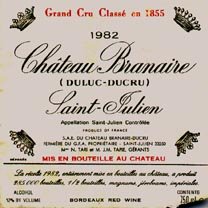
The cork was a bit of a bugger to get out, splitting in three places, damn thing even confounded my Butlers thief. Its one thing that I really hate about opening old bottles, and I cant wait for all these wines we are bottling under screwcap now, to mature over the years, and twenty years from now to be able to open them with ease!! So once that battle was over a small sample was poured into a glass to examine. A very clear wine, starting to look a bit dull, with a pale brick red core and a browning rim which usually indicates a good degree of maturity. On the nose the wine was a bit stinky at first, with a kind of farmyard like aroma, but that soon disappeared and the wine opened out with aromas of spiced fruit cake with quite a fruity edge to it. I was pleasantly surprised by the build up of fruity flavours on the nose, and each time I went back to sniff something else was starting to show. On the palate it was clean and quite pronounced in flavour, with the Dundee cakey flavours followed by more berry fruit flavours wrapped in the very well balanced characters of new French oak. Time has mellowed the acidity right down, and the tannins have softened up as they pass across the gums like silk, supporting the fruit flavours but never dominating them.
I think I would describe this as quite a feminine St Julien compared to more brutish Gruaud-Larose and Lagrange. I have to say that I was really impressed with this wine, more so than the 1989 which I also tasted tonight, but as it came in at 12.8% it wasnt eligable. Its on our list as Bin 230 at a not inconsiderable sum of £120 a bottle, but I really believe it is worth every pound of it.
I cant wait to read some of the other posts and see what wonderful wines the blogosphere has come up with.
Saturday, June 10, 2006
Henschke Keyneton 1986

I managed to find a couple of bottles of Henschke Keyneton Estate red 1986 on Lay and Wheelers bin end list. Ive always liked the Henschke wines, and the Keyneton was always a favourite. Up until 1999 it was made of a blend of cabernet sauvignon, shiraz and malbec, but in 99 they changed the malbec for merlot. Personally I think it was much better with the malbec as it had a more polished finish and a character that I cant really define. Dont get me wrong, it is still a great wine, and at a great price too, its a good introduction into the Henschke way of winemaking.
I sold a bottle of the 86 the other day, to someone who I honestly wouldnt have figured to go for that kind of wine. All of which shows that you cant always judge a book by its cover. I was pleasantly surprised by the wine, which showed really vibrant fruit character on the nose - big stone fruits, berries and currants with that aroma of prunes and aged fruit that I find in mature reds. (As an aside it had this awful plastic capsule which was a nightmare to remove). The colour was a gloriously violet red with russet brown rim. It was a bit dull with some hazing, but I put that down to being slightly disturbed bringing it up from the cellar. On the palate it was a fantastic wine, really rich fruit following on from the nose, with soft supple tannins still and a touch of acidity still. I dont believe that there is much more lifespan left to the wine, its not a keeper, but by heck its drinking well now. I only hope the other five bottles are as alive as that one was.
En Primeurs and our buying strategy
At the moment the 2005 Bordeaux en primeur campaign is building towards it climactic moment when the top 10-15 chateaux release their grands vins at ever more grand prices. This year we have taken a back seat to all this and decided not to purchase anything en primeur. Nothing at all, not even the DRC. All of which means we will surrender our allocations for this year and in all likelyhood if we decide to purchase next year we will have to start right at the bottom of the queue again. Its a decision that I may well come to regret several years down the line, when the cost of 2005 bordeaux may well be astronomical, and we try to purchase some stock to add to the wine-list. But its a decision that I took for a number of reasons. Our market is changing and evolving, our client base is getting younger, and that means that the sales are shifting more towards the new world. So does it make sense to continue purchasing stock that in all likelyhood you wont have a demand for in five or more years when it is ready to drink? I dont think so, and so did Ross, as he supported that decision not to purchase.
So this has forced me to look at the way we stock our cellar. Currently we have 70+ beverage suppliers on the books, of which only about 40 odd are actually active. Out of that forty, about 25 to 30 recieve regular orders, with the core of the volume being split between three suppliers. These three suppliers provide all of the banqueting wine-list, two thirds of the brasserie wine-list and close to a quarter of the Arkle list. (Although if you count previous purchases that we are holding in the cellar while it mature, then Gerrard Seel accounts for nearly 40% of the Arkle list.). Now most of the volume on the hotels stock is across the bottom end of the wine-lists. Almost all of it is sub £30, and that is made up of Banqueting and Brasserie stock. Now for the Arkle wine-list, my aim is to move towards buying a lot more of the stock through brokers. We will have a core section of the list, which will rarely change - all your "comfort" wines like Sancerre, Chablis, Pouilly Fume, Fleurie etc etc. Then with the rest of the list, I will have the freedom to manipulate the list according to the seasons, menu, my current tastes, and of course to respond to the market demands a lot more.
By buying from brokers we can purchase smaller parcels of stock that are ready to drink. Instead of being bound to purchasing several cases of wine, we will be able to buy half a dozen or so bottles, and when the wine is gone we can either replenish it, or replace it. This means that the wine-list can be a lot more pro-active to the needs of the customers. It also means I can match the list more accurately to the menu, and so change it seasonally when Simon Radley changes the menu. Which will help me to sell the wines as they can be more specifically matched to dishes.
As the prices for the top bordeaux are released soon, Im hoping that Ive made the right decision, but ultimately Im sure that I have and that the business will prove that. The next five or more years will be very interesting to watch how the prices change.
So this has forced me to look at the way we stock our cellar. Currently we have 70+ beverage suppliers on the books, of which only about 40 odd are actually active. Out of that forty, about 25 to 30 recieve regular orders, with the core of the volume being split between three suppliers. These three suppliers provide all of the banqueting wine-list, two thirds of the brasserie wine-list and close to a quarter of the Arkle list. (Although if you count previous purchases that we are holding in the cellar while it mature, then Gerrard Seel accounts for nearly 40% of the Arkle list.). Now most of the volume on the hotels stock is across the bottom end of the wine-lists. Almost all of it is sub £30, and that is made up of Banqueting and Brasserie stock. Now for the Arkle wine-list, my aim is to move towards buying a lot more of the stock through brokers. We will have a core section of the list, which will rarely change - all your "comfort" wines like Sancerre, Chablis, Pouilly Fume, Fleurie etc etc. Then with the rest of the list, I will have the freedom to manipulate the list according to the seasons, menu, my current tastes, and of course to respond to the market demands a lot more.
By buying from brokers we can purchase smaller parcels of stock that are ready to drink. Instead of being bound to purchasing several cases of wine, we will be able to buy half a dozen or so bottles, and when the wine is gone we can either replenish it, or replace it. This means that the wine-list can be a lot more pro-active to the needs of the customers. It also means I can match the list more accurately to the menu, and so change it seasonally when Simon Radley changes the menu. Which will help me to sell the wines as they can be more specifically matched to dishes.
As the prices for the top bordeaux are released soon, Im hoping that Ive made the right decision, but ultimately Im sure that I have and that the business will prove that. The next five or more years will be very interesting to watch how the prices change.
Tuesday, June 06, 2006
Wine Blog Wednesday 22, alcohol levels and taxation
The theme for Wine blog wednesday 22 has been announced and this month its a low(ish) alcohol red wine - ie less than 12.5% ABV. So when I read that was to be the theme, I went down into the cellar and started having a wee peek at some of the alcohol levels to see if there was anything here I might be able to use. Not much! There were a few wines, so next week I'll post my tasting notes on that one.
That got me thinking about alcohol levels though. This lunchtime Ive just served a lunch for eight people in the Arkle with four wines. We started off with Dom Ruinart 1993 which weighs in at 12.5%. So if that were red it might well qualify (barely!). Then with the first course of a cold gazpacho with langoustine tails and cucumber I served a Fiano di Avelino from Feudi di San Gregorio. At 13% abv this isnt too bad, but its edging onto the high end for a white wine. The main course of steamed turbot with asparagus, scallops, peas and morels was paired with a 13.5% Chassagne Montrachet "les Masures" from Jean-Noel Gagnard. You can spot the pattern of increasing alcohol levels here can't you. They finished the meal off with chocolate and praline tacos with raspberry and pistachio, paired with Rosenblums Cellars fantastic Gallagher Ranch Black Muscat. ABV? a monster 15.8%, which officially makes it a fortified wine. Which I suppose it is really, as they add neutral grape spirit to arrest the fermentation before all the sugar turns to alcohol. Now without planning it, that meal featured escalating alcohol levels. As i searched the cellar the other day for wines for WBW22, I was more than a bit surprised at the numbers. I found less than a handfull of wines under 13%, quite a lot between 14 and 15% and I was actually a bit taken aback by the numbers over 15%. There were over a dozen wines over 15%, and I must say every one of them came from the New World, mostly California, but a couple from South Africa and Australia and even one New Zealander. I guess it has opened my eyes a little bit.
Part of the "problem" is the increasing levels of ripeness that are being acheived these days. As our knowledge of viticulture increases, and the more accurate placement of vineyards and varietal planting increases, the end result is that grapes are reaching super levels of ripeness, and all the right sugars present them with very high potential alcohol levels - that is that if all the sugar is converted to alcohol. Now if they halt the fermentation before all the sugar is converted then you end up with quite a lot of residual sugar - hence a sweeter wine. Some residual sugar is tolerable, but too much and it becomes a medium sweet wine or even a dessert wine. If thats your aim then well done, but if you want a bone dry wine, you face the potential of 15%abv or higher. In the UK that means you are taxed as a fortified wine, which is why these big alcohol wines are so expensive because the rate of duty has increased to nearly £2.20 per bottle (compared to £1.45 for wines less than 15%){lets not forget that on top of the duty you have to pay VAT not only on the wine but the duty is vatable as well!!!}. So the moral of the story is that I guess it pays to keep an eye on the alcohol levels on the wines!!
Happy Devil day (todays date is 06/06/06!!)
That got me thinking about alcohol levels though. This lunchtime Ive just served a lunch for eight people in the Arkle with four wines. We started off with Dom Ruinart 1993 which weighs in at 12.5%. So if that were red it might well qualify (barely!). Then with the first course of a cold gazpacho with langoustine tails and cucumber I served a Fiano di Avelino from Feudi di San Gregorio. At 13% abv this isnt too bad, but its edging onto the high end for a white wine. The main course of steamed turbot with asparagus, scallops, peas and morels was paired with a 13.5% Chassagne Montrachet "les Masures" from Jean-Noel Gagnard. You can spot the pattern of increasing alcohol levels here can't you. They finished the meal off with chocolate and praline tacos with raspberry and pistachio, paired with Rosenblums Cellars fantastic Gallagher Ranch Black Muscat. ABV? a monster 15.8%, which officially makes it a fortified wine. Which I suppose it is really, as they add neutral grape spirit to arrest the fermentation before all the sugar turns to alcohol. Now without planning it, that meal featured escalating alcohol levels. As i searched the cellar the other day for wines for WBW22, I was more than a bit surprised at the numbers. I found less than a handfull of wines under 13%, quite a lot between 14 and 15% and I was actually a bit taken aback by the numbers over 15%. There were over a dozen wines over 15%, and I must say every one of them came from the New World, mostly California, but a couple from South Africa and Australia and even one New Zealander. I guess it has opened my eyes a little bit.
Part of the "problem" is the increasing levels of ripeness that are being acheived these days. As our knowledge of viticulture increases, and the more accurate placement of vineyards and varietal planting increases, the end result is that grapes are reaching super levels of ripeness, and all the right sugars present them with very high potential alcohol levels - that is that if all the sugar is converted to alcohol. Now if they halt the fermentation before all the sugar is converted then you end up with quite a lot of residual sugar - hence a sweeter wine. Some residual sugar is tolerable, but too much and it becomes a medium sweet wine or even a dessert wine. If thats your aim then well done, but if you want a bone dry wine, you face the potential of 15%abv or higher. In the UK that means you are taxed as a fortified wine, which is why these big alcohol wines are so expensive because the rate of duty has increased to nearly £2.20 per bottle (compared to £1.45 for wines less than 15%){lets not forget that on top of the duty you have to pay VAT not only on the wine but the duty is vatable as well!!!}. So the moral of the story is that I guess it pays to keep an eye on the alcohol levels on the wines!!
Happy Devil day (todays date is 06/06/06!!)
Friday, June 02, 2006
Quirky wines
I love quirky wines, wines that are a little bit out of the ordinary. They can be unusual grape varieties like the Picpoul de Pinet or Fiano di Avelino, or it might be that the winemaker has tried to make something a little extraordinary. There are several reasons why I like these kind of wines, the principle reason being that they have a story to tell. A good salesman will tell you that if you have a short story to tell about a product it hooks the customer in. It allows you to create an affinity for a product, and make a small bond, but it also personalises the product. No longer is this wine one of 600 different wines on the wine-list, now you know a little something about it, that makes it stand out from the rest slightly. Everybody knows that you rarely chose an unknown entity over a known one. The other reason that I like these wines, is that usually the guys that make these oddball wines, or who resurrect the forgotten grape varieties are deeply passionate about what they create. This means they enter into the process with a plan, they are dedicated to what they produce and they will often go to sometimes extreme lengths to ensure a great product is the end result.
One such wine is one that I served tonight. When John and Charlie Sykes from Frogg Manor walked in tonight I knew it was a golden opportunity for me to roll out one of my new acquisitions - Frogs Leap cellars Leapfrogmilch. Needless to say they loved it, from its germanic style packaging - a not-so-subtle homage to liebfraumilch, to its more new world style flavours and off dry finish. The Leapfrogmilch is a blend of Riesling (67%) and chardonnay (33%), made by John Williams, the winemaker at Frogs Leap. Now John runs the farm on Biodynamic principles - carrying out certain vineyard functions according to the cycles of the moon, and the farm has held its organic accreditation for quite a few years now. But it goes much deeper than that. The philosophy behind Frogs leap is that the vineyard and farm are a living microcosm, so they are trying to run the estate on sustainable principles.They have even brought solar energy into the process. So behind that quirky, jokey name, lies a serious product with some very conciencious thinking.
So what does it taste like. Well it has quite a floral nose - white flowers and citrus fruits - grapefruit and lime with a gala apple aroma thrown in for added complexity. It has that kind of wet gravel drive minerality too. On the palate it is still quite acidic, but it is a good balance for the fresh fruity flavours that come out. The wine feels to have a slight spritz on the tip of my tongue, but I put that down to the acidity levels. The end finishes with a slight hint of some residual sugar and quite a pleasantly long finish. I think that really this is more of a food wine than a sitting drinking on its own wine, but it would work quite well with a wide range of dishes, even some darker fish like tuna or meatier dishes like a lightly glazed duck. And like a badly planned pun it went really well with the frogs legs in Artichoke veloute.
http://www.frogsleap.com/
click on the trade section to get some more information about their organic principles and solar energy use.
One such wine is one that I served tonight. When John and Charlie Sykes from Frogg Manor walked in tonight I knew it was a golden opportunity for me to roll out one of my new acquisitions - Frogs Leap cellars Leapfrogmilch. Needless to say they loved it, from its germanic style packaging - a not-so-subtle homage to liebfraumilch, to its more new world style flavours and off dry finish. The Leapfrogmilch is a blend of Riesling (67%) and chardonnay (33%), made by John Williams, the winemaker at Frogs Leap. Now John runs the farm on Biodynamic principles - carrying out certain vineyard functions according to the cycles of the moon, and the farm has held its organic accreditation for quite a few years now. But it goes much deeper than that. The philosophy behind Frogs leap is that the vineyard and farm are a living microcosm, so they are trying to run the estate on sustainable principles.They have even brought solar energy into the process. So behind that quirky, jokey name, lies a serious product with some very conciencious thinking.
So what does it taste like. Well it has quite a floral nose - white flowers and citrus fruits - grapefruit and lime with a gala apple aroma thrown in for added complexity. It has that kind of wet gravel drive minerality too. On the palate it is still quite acidic, but it is a good balance for the fresh fruity flavours that come out. The wine feels to have a slight spritz on the tip of my tongue, but I put that down to the acidity levels. The end finishes with a slight hint of some residual sugar and quite a pleasantly long finish. I think that really this is more of a food wine than a sitting drinking on its own wine, but it would work quite well with a wide range of dishes, even some darker fish like tuna or meatier dishes like a lightly glazed duck. And like a badly planned pun it went really well with the frogs legs in Artichoke veloute.
http://www.frogsleap.com/
click on the trade section to get some more information about their organic principles and solar energy use.
Saturday, May 27, 2006
Adding to the list.
Well last night I added about twelve wines to the wine-list. Its quite a long-winded process from start to finish. Heres a rundown on the process from the beginning.
Often I will encounter a new wine at a tasting, this may be here at the hotel with a sales rep and possibly a winemaker or winery marketing manager, or sometimes its one of those rare occasions that i get out of the hotel to a large trade tasting. Once I decide that the wine merits inclusion on our list, I have to negotiate a suitable price with the supplier. Usually we will just run with the listed price, but if we are looking at putting it on the list by the glass we will try and seek a better price. After all we are going to be purchasing the wine in some volume and so that helps make it more economical for both parties. Once I have my price, the next stage is to enter it into our stock computer and generate a bin number. When our cellar was first computerised many years ago, i dont think that they really thought about how big the list was going to be and so the numbering has become quite random. I would much prefer to have the numbers mean something. In other words allocate certain number orders to certain wines - 0 to 100 for champagne, 120 to 180 for Loire and Rhone, 200 to 400 for Bordeaux, 450 to 800 for burgundy etc etc. But to try and do that now would require a major reshuffle of the database and its not a task that i would relish doing myself.
Anyway, now we have the bin number we create a purchase order, get it signed off and order the stock. Once the stock is delivered it gets entered into the stock control system and the fun begins. Once I know that the stock is here, I have to start thinking about price. Now whether I like it or not, the margins that we are operating to are a bit higher than a stand-alone restaurant. We have considerable operating costs - we use Riedel stemware, flowers, payroll costs, linen, food costs, etc etc, but we are also contributing to supporting a whole hotel. So our margins are a bit higher than Im entirely comfortable with. Having said that, there are a few items that I can play around with, and so scattered around the wine-list there are some real bargains to be had, for those people with a bit of imagination, who take the time to read the list or ask for my support. We operate a floating margin, so that the wines at the upper spectrum of the list are marked up less than the house wines. (Insider advice - never order the house wine, as that is the most marked up wine on the wine-list. On my list you will find the best value for money between £50 and £90 on the wine-list). Once I have my selling price, I need to program it into our EPOS system. Then I find a space on the wine-list, type in the details, careful to make sure Ive spelt everything correctly (I copy the details exactly as they are on the wine labels. If the label is wrong, thats how it goes on the list), and paying careful attention to the vintage. Then I'm ready to rock and roll.
So what delights are on the list today?
a) Ata Rangi Martinborough Pinot Noir 2003. A stunning Pinot from one of the North Island of New Zealands best producers. 2003 was a great vintage, with very, very low yields and really intense fruit. This comes across with ultra ripe cherry flavours and and underpinning cedar/seasoned woody character. Really it needs a little more time in the bottle to get the best out of it, but its a stonking wine. Its not cheap at £85.00, but this was selling for nearly twice as much in Otago and sold out in days.
b)Matakana Estate, Matakana Moko 2000. Fantastic bordeaux blend wine from the northern most reaches of the North Island again. This is a maori produced wine, Moko being the traditional Moari facial tattoo's. Intense curranty berry fruit flavours with tightly integrated toasty oak characters. The tannins are starting to settle down and balancing the wine nicely. Still it needs a good half hour after decanting to really open out and show the forward fruity flavours.
c) A et P de Villaine, Mercurey Rouge "les Montots" 1996. Fantastic little Mercurey red from the principle name behind Domaine de la Romanee Conti, Aubert de Villaine. With a bit of bottle age on it this wine has really developed the distinctively earthy flavours that only Burgundy seems able to produce. This is simple red burgundy at its peak of perfection, and a wallet friendly £35 a bottle.
d)Domaine du Vissoux Fleurie "Poncie" 2004. Im not really a fan of Fleurie, personally I prefer Morgon and the deeper, darker Beaujolais cru's, but this wine makes me reconsider my tastes. A vibrant purple colour, with that classic beaujolais nose of strawberries and a hint of bubblegum. This wine takes a few moments to settle into character, but when it does it doesnt disappoint. Beaujolais is a sommelier "get out of jail free card". It seems to work really well with almost any food, and is usually a good crowd pleaser,suiting most palates and wallets at the same time.
Well thats about all for now, I need to get ready for service.
grazza
Often I will encounter a new wine at a tasting, this may be here at the hotel with a sales rep and possibly a winemaker or winery marketing manager, or sometimes its one of those rare occasions that i get out of the hotel to a large trade tasting. Once I decide that the wine merits inclusion on our list, I have to negotiate a suitable price with the supplier. Usually we will just run with the listed price, but if we are looking at putting it on the list by the glass we will try and seek a better price. After all we are going to be purchasing the wine in some volume and so that helps make it more economical for both parties. Once I have my price, the next stage is to enter it into our stock computer and generate a bin number. When our cellar was first computerised many years ago, i dont think that they really thought about how big the list was going to be and so the numbering has become quite random. I would much prefer to have the numbers mean something. In other words allocate certain number orders to certain wines - 0 to 100 for champagne, 120 to 180 for Loire and Rhone, 200 to 400 for Bordeaux, 450 to 800 for burgundy etc etc. But to try and do that now would require a major reshuffle of the database and its not a task that i would relish doing myself.
Anyway, now we have the bin number we create a purchase order, get it signed off and order the stock. Once the stock is delivered it gets entered into the stock control system and the fun begins. Once I know that the stock is here, I have to start thinking about price. Now whether I like it or not, the margins that we are operating to are a bit higher than a stand-alone restaurant. We have considerable operating costs - we use Riedel stemware, flowers, payroll costs, linen, food costs, etc etc, but we are also contributing to supporting a whole hotel. So our margins are a bit higher than Im entirely comfortable with. Having said that, there are a few items that I can play around with, and so scattered around the wine-list there are some real bargains to be had, for those people with a bit of imagination, who take the time to read the list or ask for my support. We operate a floating margin, so that the wines at the upper spectrum of the list are marked up less than the house wines. (Insider advice - never order the house wine, as that is the most marked up wine on the wine-list. On my list you will find the best value for money between £50 and £90 on the wine-list). Once I have my selling price, I need to program it into our EPOS system. Then I find a space on the wine-list, type in the details, careful to make sure Ive spelt everything correctly (I copy the details exactly as they are on the wine labels. If the label is wrong, thats how it goes on the list), and paying careful attention to the vintage. Then I'm ready to rock and roll.
So what delights are on the list today?
a) Ata Rangi Martinborough Pinot Noir 2003. A stunning Pinot from one of the North Island of New Zealands best producers. 2003 was a great vintage, with very, very low yields and really intense fruit. This comes across with ultra ripe cherry flavours and and underpinning cedar/seasoned woody character. Really it needs a little more time in the bottle to get the best out of it, but its a stonking wine. Its not cheap at £85.00, but this was selling for nearly twice as much in Otago and sold out in days.
b)Matakana Estate, Matakana Moko 2000. Fantastic bordeaux blend wine from the northern most reaches of the North Island again. This is a maori produced wine, Moko being the traditional Moari facial tattoo's. Intense curranty berry fruit flavours with tightly integrated toasty oak characters. The tannins are starting to settle down and balancing the wine nicely. Still it needs a good half hour after decanting to really open out and show the forward fruity flavours.
c) A et P de Villaine, Mercurey Rouge "les Montots" 1996. Fantastic little Mercurey red from the principle name behind Domaine de la Romanee Conti, Aubert de Villaine. With a bit of bottle age on it this wine has really developed the distinctively earthy flavours that only Burgundy seems able to produce. This is simple red burgundy at its peak of perfection, and a wallet friendly £35 a bottle.
d)Domaine du Vissoux Fleurie "Poncie" 2004. Im not really a fan of Fleurie, personally I prefer Morgon and the deeper, darker Beaujolais cru's, but this wine makes me reconsider my tastes. A vibrant purple colour, with that classic beaujolais nose of strawberries and a hint of bubblegum. This wine takes a few moments to settle into character, but when it does it doesnt disappoint. Beaujolais is a sommelier "get out of jail free card". It seems to work really well with almost any food, and is usually a good crowd pleaser,suiting most palates and wallets at the same time.
Well thats about all for now, I need to get ready for service.
grazza
Wednesday, May 24, 2006
Cellar work
The cellar is looking a bit of a mess at the moment, as there have been lots of new arrivals and we havent had a chance to rack them up yet. Ross has been really good recently and allowed me an almost free reign to get some new stock. Ive taken this opportunity to fill in some major gaps in the wine-list and bulk up some weaker regions. New Zealand has nearly tripled in size from seven wines to nearly 25 by the time Ive added the new wines. Im now working on Australia a bit. I aim to make the Aussie section upto three pages long. Five if you include the two special pages that Im planning on putting together (Charles Melton and Henschke). Then its South America and South Africa that need some TLC, and the Loire could do with a bit of a boost. Then I want to work on my next project which is a Wine Century - 100 different grape varieties. I posted earlier about managing to taste 100 different grape varieties and so gaining entry into the Wine Century club. So I figured it might be a really cool couple of pages in the winelist if i did a Wine Century. Ive got some really cool obscure ones that would work really well with the menu, so they would be saleable. For example I tasted a Cour-Cheverny from France which is made from the Romorantin grape. I reckon that I probably have about 40 varieties at the moment anyway, so Im not going to have to search too hard perhaps.
Anyway this afternoon Im going to spend most of the afternoon in the cellar like a troglodyte racking up the red wines that have come in. After all its stocktake this weekend so the more I can do now, the easier that will be.
grazza
Anyway this afternoon Im going to spend most of the afternoon in the cellar like a troglodyte racking up the red wines that have come in. After all its stocktake this weekend so the more I can do now, the easier that will be.
grazza
Friday, May 19, 2006
Help Save Margaux
I got an email this afternoon from our J&B rep, asking me to help support the vignerons of Margaux fight the Ministry of Transport, who wish to build and autoroute through the middle of Margaux to help reduce congestion in the city of Bordeaux. After seeing a posting on Dr Vino's blog about how the estate of Haut-Brion is now almost completely surrounded by urbanisation (http://drvino.blogspot.com/2006/05/city-swallows-first-growth.html) it got me thinking. Over the latter half of the 1700's and into the 1800's the industrial revolution increasingly eroded away our agrarian lifestyle and as the cities expanded outwards the countryside disappeared at an alarming rate. Now having seen the effects of such urbanisation of the countryside and the ever spreading tentacles of concrete and tarmac, we wish to reduce or stop the growing network of roads. Especially if its going to mean less Margaux. Good god, the prices are expensive enough!! Can you imagine the negociants at the en primeur campaign in 2010?
Negoce: " so Monsieur Margaux winemaker, how much is your lovely wine this year?"
Winemaker: "Ah well you see, because the autoroute cut my vineyards in half, the yields have been reduced in half, the wind and vibration from the traffic caused most of my fruit to drop off early, further reducing the yields and what was left was heavily polluted with carbon emissions, petrol fumes and dust. All this cost me lots of money, so take what it cost last year and triple it!! "
Seriously though, help protect the winemakers of Margaux, protect their livelyhoods and stop this madness by adding your name to the petition online at http://www.margaux-danger.com/
grazza
Im getting a commis!!
Not a hundred percent confirmed yet, but its looking likely that Im going to be getting a commis in the next couple of months. This is good news for me, as it means that I will have that bit of regular support on busy shifts. It also means that in the future, I might be able to get the occaisonal night off, or early night at least. But I think that its going to be good for me in the long run, because it means that Im going to have someone to mentor and develop. Thats means a lot more responsibility for me as well, but Im more than ready to handle that aspect of it. Its something that I havent really had since Gleneagles, so I relish the challenge.
Saturday, May 13, 2006
The most famous vineyard in the world

Found this picture on the internet. It comes from www.wineloverspage.com, and is used without permission (but I am seeking permission). Follows on from my previous posting about La Romanee Conti. This is it folks.
grazza
It's over at last!!!
The May races ended yesterday on quite a high for us. We broke last years record daily total last night by a monster £4000. All thanks to one table and their purchase of the 1999 Domaine de la Romanee Conti, La Romanee Conti for a smooth £3500. I was chuffed when Paco told me they wanted the Romanee St Vivant 99 (£465) but when I presented the bottle, the guy said, "No! No! I want La Romanee Conti!". My heart started racing, my palms got sweaty, I felt elated, numb and more than a little scared.Paranoia set in and I started imagining what if it was corked, what if he says I don't like it. All sorts of nightmare scenarios start running through my mind. But I'm also excited at the prospect of tasting it .I've never tasted La Romanee Conti before.I've read plenty about it, Clive Coates, Michael Broadbent, Serena Sutcliffe all heap praise and adoration upon it.
Before I start the tasting notes, perhaps I ought to explain why La Romanee Conti is so expensive. La Romanee Conti is a tiny little Grand Cru vineyard of about 1.8 hectares (a little over 4 acres). The vineyard has remained the same since it was first purchased by the monks of the St Vivant priory over 750 years ago. It is planted to Pinot Noir, with the average age of the vines being 52 years old. This means that the gnarly old vines will produce less than half the crop of younger more vigorous vines, but Mother Nature compensates for that by having the fruit more concentrated in flavours, sugars and all the necessary ingredients for making outstanding wines. Each patch of vineyard has its own dedicated worker, who will attend to their parcel of vines all year round. Early in the growing season the workers will severely prune the vines, and a practice called eclaircissage (green pruning) is used to further reduce the yields. As the grapes ripen and approach maturity the workers complete a passage de nettoyage to remove any substandard or malformed grapes. Once the grapes have reached their optimal ripeness they are hand harvested individually by the workers, supplemented with sixty pickers. The grapes are then sorted into small baskets and all are checked manually on a triage table before beginning the winemaking process.
Domaine de la Romanee Conti practice a minimal intervention style of winemaking. The grapes are not destalked, which combined with the long period of cuvaison (upto a month) gives the wines a deeply structured tannin backbone, which undoubtedly contributes to their cellaring ability. The fermentation is carried out a relatively low temperatures, never reaching above 33degrees, before the wine is transferred into is own supply of 100% new troncais oak casks. The wines are never filtered and rarely fined. If they require fining the maitre de chai Bernard Noblet is sent to acquire a few hundred fresh eggs. After between sixteen and twenty-two months in oak the wines are deemed ready to be bottled, which is carried out cask by cask, and done manually using gravity as the pumping agent.
After all this effort, care and attention the end result is less than 500 cases of wine, each bottle individually numbered. They are released annually on subscription and the UK allocation is managed by Corney and Barrow. Interested buyers are asked to submit their purchase requests, and stock is allocated by demand and based on previous purchasing from C&B, i.e. the more you have bought from them last year, the more likely you will get all that you want this year. It isn't cheap, typically a bottle of La Romanee Conti will set you back somewhere in the region of £800-£1200 on the primary market, depending on the vintage. But once you have been given your allocation and paid for it, the fun really begins.
The market for DRC is very buoyant, and it is widely regarded as the most stable of the "Blue Chip" wines. Every year come allocation time, the demand always exceeds the supply, more so in exceptional vintages. It is quite common for a wine to have been sold several times, before it is even in a bottle, and for its subsequent value to have risen to in excess of £2000 a bottle. So if you were fortunate to have been allocated 6 bottles, you could stand to make some serious return on your investment. And this is why DRC wines are so very popular with collectors and investors in wine, and consequently one reason why it fetches such high prices. Small production, high demand.
So, ultimately is it worth it? I cant answer that question for you, but what I would say is if you have to think about it, or even if you ask that question then I would say that the answer for you is no. Would I pay £3500 for it? If money wasn't an issue, then I suspect I would.It really depends on the circumstances. In case you were wondering the wine was outstanding! A really vibrant nose of fresh soft red fruits, with an undercurrent of earthiness and a kind of growbag aroma. On the palate it was amazing, layer after layer of flavour kept rolling back and revealing more and more flavour. Being quite young there was a lot of fruit flavours, but there was quite a soft tannic structure with a pleasantly acidic mouthfeel, with a lot more cherry red fruit flavours and wild strawberries. It was a very feminine wine, gentle on the palate, slowly revealing more flavour and depth. Very seductive. I have to say it was the most complex wine that I have ever tasted. By that I mean that there was something different with every moment, and it revealed more flavours and layers with each second it was on my tongue.
So that was May races 2006. I'm glad its over, and I can't wait until tonights service is over for two well deserved days off. It's been a hell of a long busy week, but the sales have been good, the service has gone really quite well, we havent had any serious trouble and all we need to do now, is get through the rest of the month and wait until the tips come!!
grazza
Tuesday, May 09, 2006
May Races
Well its that time of the year again, May Races start tomorrow. Tomorrow is meant to be the start of our three busiest days of the year, but its looking a bit millenium tomorrow. Numbers for Wednesday are a bit poor, and its not just us. Seems most of the city is suffering tomorrow. Oh well, Im sure thursday and friday will make up for it.
grazza
grazza
Thursday, May 04, 2006
Anticipating things to come
Im starting to get excited about some of the wines that are coming onto the wine-list. Its a combination of springtime turning into summer, and now that our audit and year end is out of the way, the pursestrings are relaxed a bit and I get to go wine shopping. Today we placed an order for about a grands worth of new wines, the majority of which are from New Zealand.
New Zealand is a country I'm getting quite excited about now. They've been producing some cracking wines there since the 80's when they turned their focus from really quite naff hybrid varieties like Muller-Thurgau to more noble varieties like Sauvignon Blanc, Pinot Noir, Syrah, Cabernet, Merlot, Chardonnay, Riesling and Gewurztraminer. It was the seminal Cloudy Bay which brought New Zealand kicking and screaming to the forefront of our wine marketplace with their bright fruity Sauvignon blanc back in 1986. Since then Cloudy Bay has remained a firm icon, and it retains an air of cultishness with its allocated sales and the sheer difficulty that most people have getting any. But there are new kids on the block whose wines are set to eclipse those of Cloudy Bay. In some cases the teams behind them have been through the ranks and Cloudy Bay and learnt their craft from the master. Wines like Dogpoint Vineyards, which started life as a kind of afterwork project for James Healy and Ivan Sutherland when they both worked at Cloudy Bay. Their straight Sauvignon blanc is stainless steel fermented to give it that crisp fruity style we've come to expect of a NZ savvy, but for me their best wine is the sublime Section 94 Sauvignon. This wines undergoes partial fermentation under oak, with the grapes often being crushed in the barrels. James uses natural yeasts to ferment the wines which usually takes longer to ferment, resulting in a more powerful flavour, with autolytic characters, and the most amazing elderflower and jasmine aromas underpinned by the herbal citrus and tropical fruit flavours we often find in NZ savvy.
Anyway a good friend of mine Neil Taylor is working over in New Zealand at a wine shop in Otago, and he's putting together a parcel of rare and exclusive New Zealand wines - pinots, savvy's, some rieslings, some gewurzt and some pinot gris too. All of these wines are going to be from quality producers, some will be single vineyard offerings, others will be rare and most of them will be exclusive to us. Once I know whats coming I'll post it on here. But in the meantime Ive got some great Pinot coming from a winery called Mt Difficulty in Central Otago. Matt Dicey the winemaker, makes some great single vineyard Pinots (which I should be getting in about eight weeks) but his straight Pinot and Sauvignon are fantastic. Central Otago is the most southerly commercial wine region in the world, and it really only turned to viticulture in 1981 when Alan Brady established vineyards for Gibbston Valley Winery. Now it's regarded as one of the trendiest regions, an area perfect for cooler climate varieties like Pinot Noir and Riesling. With its cold winters and long dry summers, it presents climactic conditions similar to Europe. Now Brady owns Mt Edward which just makes Pinot Noir, and although it is expensive (all NZ wines are expensive, but Mt Eddie is nearly double the cost of Cloudy Bay!!) it is worth every penny and more.
Check out the following websites for more information about the wines:
cheers!
grazza
Wednesday, May 03, 2006
New Gastro Menu
Well the Gastro menu changed yesterday, but i was kinda busy with a few things and so I couldnt update the blog.
Anyways, here it is, with a brief note of what wine Im pairing it with.
Anyways, here it is, with a brief note of what wine Im pairing it with.
Starter
Scallop with anise jelly and fennel
the aniseed is very dominant in this dish so there are a couple of wines that i think this will work with. The first is a Picpoul de Pinet from Chtx St Martin de la Garrigue in the Languedoc. Its a sharp, acidic white with a citrus nose. Its name actually means lip stinger in french and you would see why.
The other wine i might pair this with is a Fiano di Avelino from Feudi di San Grigorio. A native italian grape variety, this is moderately to highly acidic, with a slightly nutty character to it.
Intermediate
Monkfish pan fried with truffled ox cheek and parsley
Ive paired this off with a premium Sake from Yamatagowa. Its Rashiku Ginjo Sake, it comes it at a hefty 15.6%ABV, so you are only .4% away from being classified as a fortified wine!! This is very similar in style and in some flavour characters to a viognier. But its high alcohol content helps cleanse the palate.
Main course
Chelford Beef, herb poached with a sweetbread ravioli and seared foie gras.
For this wine, Ive chosen to go classical, after the off the wall previous choice. Ive chosen a claret from Chateau Bauduc, "Clos des Quinze" 2001. This is a great easy drinking claret from a young english couple, Gavin and Angela Quinney. Dominated by Merlot this wine has lots of complementary flavours that accent the herb poached beef, and the earthyness of the sweetbreads.
Pre-Dessert
Orange Sorbet and Champagne Granite
this is intended as a palate cleanser and as such i dont match anything with this.
Dessert
Trio of Apricot - Tatin, sorbet and melba
Not too sure about this one just yet. At the moment Im experimenting with a Cabernet Franc icewine from Canada's Pelee Island. A rose red sticky sweet wine with a subtle hint of winterberries and rosehip. Ill have to report back during the week to see how i get on with this one.
Well the menu is delicious, although personally, the fennel and anise are just a bit too dominant for my liking, but hey its horses for courses. Speaking of horses, next week sees the start of the racing season at Chester, and its our busiest week of the year. Cant wait - NOT!
grazza
Friday, April 28, 2006
Sidetracked pt 2
When looking at matching food to wine there are a number of factors that need to be considered. With desserts the principle "rule" is that the wine should be sweeter than the dessert it is being paired with. If it isnt the end result is usually an unpleasant metallic taste on the palate. Creamy dishes need something with a reasonable amount of acidity to cleanse the fats off the palate. Other than that almost anything goes.
When im matching food and wine, I try to find flavours that complement each other. A classic example is chocolate and orange, a match for which Terry's chocolate companty have survived for decades. But there are many different types or grades of chocolate - milk, white, and varying degrees of dark with cocao contents varying from 30% to 80%. As well as this the sweetness of the chocolate varies with the darker higher cocao chocolates usually containing much less sugar than milk chocolate. So it all boils down to tasting combinations. The more bitter the chocolate the sweeter the wine can be to counterbalance the bitterness.
Currently we have a dessert on the gastro menu which is a dark chocolate collar with a bitter chocolate orange sorbet and caramelised orange sauce. Now you have two fairly bitter, unsweetened parts, with the caramel sauce providing the sweetener. So really the wine doesnt need to be megasweet. If im doing menu-matching with this then what I would do is offer two different glasses of wine per couple. The first is an Orange Muscat from a winemaker called Andrew Quady, who is based in Madera, California. Andrew used to be a pyrotechnician before turning his considerable talents to making wines. He only makes dessert wines, and some fortified port-style wines, which he calls Starboard. get it? Port - Starboard!! Anyway the wine is made from Muscat de Frontignon grape, and has a slightly orangey flavour which we know works well with chocolate. It is quite sweet, but so far the feedback has been good. The other wine that I serve is Boutielle Call from Bonny Doon Vineyards. This is a late harvest Syrah that is blended with Framboise made from three different raspberry breeds all grown in Washington State. Its a rich, unctious wine, with a fairly obvious raspberry flavour to it, which Im uncertain how it sits with the orangeyness of the dessert. The guests have been undecided with about 50% likey, 50% no likey. But its different, its unusual and if the raspberry wasnt so obvious I think it would work better. Which leads me to another wine that ought to work based on that conclusion.
Rosenblums Late Harvest Zinfandel - Rosie Rabbit vineyard. A rich deep red wine with a modicum of residual sugar. This goes really well with a chocolate fondant, or dark chocolate souffle.
Mas Amiel, Maury, a vin doux naturel from the Languedoc region of France is partially fermented Grenache that is then fortified with grape brandy to increase its alcoholic strength and halt the fermentation. The end result being that not all of the sugar has turned to alcohol, hence you have a sweet wine.
In a similar style a relatively young LBV port or port style wine would also work quite well. Weisse and Krohn do some great single colhieta aged tawnies in a multitude of vintages going back to the 50's. The 65 has a rich coffee/toffee'd nose that works well with heavy dark chocolate dishes - opera gateaux, sachertorte etc.
I havent really come across a good complement for white chocolate yet, but Im working on it!!
grazza
Thursday, April 27, 2006
Sidetracked pt 1
Ive been reading this fascinating book recently - Indulgence by Paul Richardson (http://www.amazon.co.uk/exec/obidos/ASIN/0349115524/qid=1146158669/sr=1-13/ref=sr_1_2_13/026-2295142-3323623).
The guy is a chocophile and he traces the history of chocolate from the Ancient MesoAmerican civilizations across to Spain, France, Italy and throughout Europe. Its a really interesting read and it got me thinking about flavours and how tastes evolve across time and continents. Originally chocolate was taken as a beverage and it was often "flavoured" with spices such as chilli's, annato, cinnamon, vanilla, various indiginous flowers, etc. As it moved across europe these flavours were omitted or replaced and gradually the product evolved from a fairly bitter dark product to the milky sweet chocolate we know now. But the book has prompted me to start exploring darker chocolates, and especially single estate chocolates and chocolates from different countries. Names like Valrhona, Amadia, El Rey all produce single estate chocolates, often with very high cocao contents. Apparantly most commercial chocolate contains about 30% cocao, but to really experience the flavours you should try some 50% or even 70% cocao. Here in the kitchens at the Grosvenor we have some 98% cocao pistils. It's an interesting experience as there is virtually no fat the chocolate almost crumbles in the mouth and it's very, very bitter. But if you melt it down with hot water, add in some spices and a small amount of milk or cream, you can make a very very nice hot chocolate drink.
So what wines would you pair off with something like that? All will be revealed in pt 2, coming later tonight (all being well)
grazza
The guy is a chocophile and he traces the history of chocolate from the Ancient MesoAmerican civilizations across to Spain, France, Italy and throughout Europe. Its a really interesting read and it got me thinking about flavours and how tastes evolve across time and continents. Originally chocolate was taken as a beverage and it was often "flavoured" with spices such as chilli's, annato, cinnamon, vanilla, various indiginous flowers, etc. As it moved across europe these flavours were omitted or replaced and gradually the product evolved from a fairly bitter dark product to the milky sweet chocolate we know now. But the book has prompted me to start exploring darker chocolates, and especially single estate chocolates and chocolates from different countries. Names like Valrhona, Amadia, El Rey all produce single estate chocolates, often with very high cocao contents. Apparantly most commercial chocolate contains about 30% cocao, but to really experience the flavours you should try some 50% or even 70% cocao. Here in the kitchens at the Grosvenor we have some 98% cocao pistils. It's an interesting experience as there is virtually no fat the chocolate almost crumbles in the mouth and it's very, very bitter. But if you melt it down with hot water, add in some spices and a small amount of milk or cream, you can make a very very nice hot chocolate drink.
So what wines would you pair off with something like that? All will be revealed in pt 2, coming later tonight (all being well)
grazza
Subscribe to:
Posts (Atom)