Its our last table of the night, a quiet night at that, and they are sat there pondering the wine-list. Ive had a quick look at their order, and tonight they've chosen the gastronomic menu. Im a bit surprised, the menu is quite an adventurous one this week, Simon has opted for a pigeon starter and lobster main course, but after all these years I ought to know not to make assumptions anymore. So a bit of eavesdropping and I can hear her talking about the Hunter Valley, my mind flashes across the Aussie section of the wine-list, Ive only got one Hunter wine - a semillon from Keith Tulloch. But again they surprise me when I ask if they need any help, the wine-list is closed and handed back to me with the words "Yes! We'd like you to chose us a white wine for our meal"
Forty questions run through my mind, but I dont have all night, so I cut it short - new world or old - they chose old. Crisp and dry, full bodied and oaky or somewhere inbetween? - they want something a bit more towards the oaky but not a full on oak bomb. So Im looking at Burgundy. Now bugundy is never cheap, so I have to get some kind of idea how much they are considering spending, but for all I know they guy might be on a date and I dont want to make him look cheap in front of the lady. So what I do is come up with five suggestions - three cheap to middle (£30 - 60) and two more expensive options (£50-100). He plumps for the Auxey Duresses (£45). Nice choice!
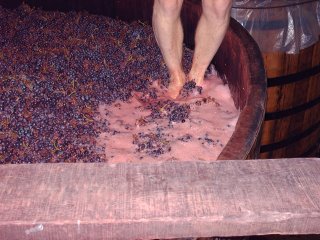
I worked the vintage at Vallet last year, and it was one of the most amazing experiences of my career. So any chance to promote Bernard's wine, and I'm there. I did the whole presenting the bottle thing, then back at my station, ran my wine-knife under the lip of the bottle in a smooth circle to cut the foil, carefully removing it. The cork smells bad, TCA bad. Now that doesnt always mean the wine is going to be tainted, but usually when the cork smells this bad, I wouldnt bet against it. Sure enough as I pull the cork out, the horribly musty smell of TCA comes full frontal out the bottle and sends me backwards. This is nasty. So a short trip down to the cellar to retrieve another bottle and we're back cooking with gas. This one is perfect, clean, prominant aromas of toasty oak, vanilla, straw and honey with a kind of beurre noisette tone to it.
They loved it.
Showing posts with label TCA. Show all posts
Showing posts with label TCA. Show all posts
Friday, June 29, 2007

Wednesday, May 09, 2007
2,4,6 Trichloroanisole (TCA)
Ive been asked this question a few times recently. So, while my nose is still out of action I thought I would use the opportunity to answer a fairly important question - what is TCA?
The most simple answer is that Trichloroanisole or TCA is a chemical compound (C7H5OCl3) that adversely affects the aroma and taste of contaminated wines. It is a highly volatile chemical that is dectactable in amazingly small concentrations in wine. In white wines the threshold is as little as 2 parts per trillion (or in slightly simpler terms 0.000000000002g in a litre of fluid - thats really small), it goes up slightly to 5 parts per trillion for reds (not sure why, maybe because reds tend to have more complex aromas going on). But having said that everyone has different tolerances to TCA. Im very sensitive to it, and consequently Ive been able to identify tainted wines that my colleagues havent. I once came across a gentleman who was completely impervious to the TCA and was quite happily quaffing a very very very badly tainted bottle. This bottle was so badly tainted that I could smell it halfway across the restaurant (the Strathearn at Gleneagles is hardly a small room!), yet he just couldnt smell the taint at all!
For those that are able to detect it, TCA presents variously as a wet cardboardy smell, damp musty cellar like aroma, wet soil, wet old wood, or sometimes a slightly penicillin-ish like aroma. Depending on the concentrations in the wine, the aroma can be very subtle or seriously pronounced. If the wine is very cold, then the TCA will be held in solution in the wine and the aromas will be very difficult to detect until the wine warms up and the TCA becomes more volatile. This is often why in a restaurant a wine will be passed fit for service by either the sommelier or the customer (or both) and then as the wine warms up in the glass the TCA becomes more obvious and the wine is shown to be contaminated. As far as I know it isnt toxic, but considering that its primary chemical precurser is Trichlorophenol or TCP as it is more famously known I shouldnt think it would do you any serious damage. Particularly as it is often only found it very minute concentrations.
There is a huge amount of debate as to the cause of TCA contamination. Theres actually quite a good discussion about it on wikipedia at http://en.wikipedia.org/wiki/Cork_taint which covers it in much better detail than I care to get into. Needless to say, many of the statistics surrounding actual contamination rates are subject to much speculation and skepticism depending on whom sponsored the research - the pro or anti cork lobbies are quite dominant in this arena.
For more information check out the following pages:
http://www.aromadictionary.com/articles/corktaint_article.html
http://www.wineinstitute.org/industry/tca/
The most simple answer is that Trichloroanisole or TCA is a chemical compound (C7H5OCl3) that adversely affects the aroma and taste of contaminated wines. It is a highly volatile chemical that is dectactable in amazingly small concentrations in wine. In white wines the threshold is as little as 2 parts per trillion (or in slightly simpler terms 0.000000000002g in a litre of fluid - thats really small), it goes up slightly to 5 parts per trillion for reds (not sure why, maybe because reds tend to have more complex aromas going on). But having said that everyone has different tolerances to TCA. Im very sensitive to it, and consequently Ive been able to identify tainted wines that my colleagues havent. I once came across a gentleman who was completely impervious to the TCA and was quite happily quaffing a very very very badly tainted bottle. This bottle was so badly tainted that I could smell it halfway across the restaurant (the Strathearn at Gleneagles is hardly a small room!), yet he just couldnt smell the taint at all!
For those that are able to detect it, TCA presents variously as a wet cardboardy smell, damp musty cellar like aroma, wet soil, wet old wood, or sometimes a slightly penicillin-ish like aroma. Depending on the concentrations in the wine, the aroma can be very subtle or seriously pronounced. If the wine is very cold, then the TCA will be held in solution in the wine and the aromas will be very difficult to detect until the wine warms up and the TCA becomes more volatile. This is often why in a restaurant a wine will be passed fit for service by either the sommelier or the customer (or both) and then as the wine warms up in the glass the TCA becomes more obvious and the wine is shown to be contaminated. As far as I know it isnt toxic, but considering that its primary chemical precurser is Trichlorophenol or TCP as it is more famously known I shouldnt think it would do you any serious damage. Particularly as it is often only found it very minute concentrations.
There is a huge amount of debate as to the cause of TCA contamination. Theres actually quite a good discussion about it on wikipedia at http://en.wikipedia.org/wiki/Cork_taint which covers it in much better detail than I care to get into. Needless to say, many of the statistics surrounding actual contamination rates are subject to much speculation and skepticism depending on whom sponsored the research - the pro or anti cork lobbies are quite dominant in this arena.
For more information check out the following pages:
http://www.aromadictionary.com/articles/corktaint_article.html
http://www.wineinstitute.org/industry/tca/
Subscribe to:
Posts (Atom)