Had an interesting tasting yesterday with Roger, one of our main suppliers and the winemaker and his fiancee from Mischa Estate down in Wellington South Africa. Now Ive been trying to do a bit more South African for a little while now, because I think there is a lot going on down there and the quality of wine coming out of South Africa seems to be getting better and better. Thankfully more of the farmers are moving away from the Co-ops and starting to produce their own fantastic wines. The big problem for both them and UK sommelier and customers is that at the moment many of these wines dont yet have a route to market. But that is changing and as time goes on, they will find UK importers knocking on their doors trying to get them to sell to them.
Now Andrew Barns looked more like an Aussie surfer dude than a South African winemaker, but there is no mistaking the accent. They started off by showing us their Viognier. On the nose it is recognisable Viognier - peaches and cream, a touch of floral character - white flowers and honeysuckle. There is a subtle hint of spice on the nose too, which put me in mind of a good aged Condrieu. On the palate it delivers the same fruity character, fresh and lighter than many viogniers, not at all thick and oily. The acidity is so well balanced that it finishes quite dryly and made me want to drink more. After the first spit, I didnt want to waste anymore and ended up swallowing it!! We liked this one so much, were going to list it by the glass.
We moved on to the reds next, looking first at the Eventide Cabernet 2006. There wasnt a single hint of smokyness that Mark would characterise as typical SA red. There was ample red fruit character - currants and blackberries with a spiced note of cinnamon and licorice root. The woody characters are there in a background support role, and as Andrew (the winemaker) put it, the fruit has to do the talking, not the barrel. The oak is to be used as the canvas over which the fruit character will paint the picture. I liked that, and its true, the oak presence (2nd, 3rd and sometimes 4th fill french oak) is very much in the shadows, letting the essense of the grapes be the dominant character. It had a great length and we like this one as well, enough to give it a listing.
We moved on to the Mischa Estate Cabernet 2003. Andrew explained that when they vinify the individual parcels of vines they select those that shine out for the Mischa label. This was his forth vintage, and it was easy to see the difference between the eventide and mischa wines. There was much more going on in the glass of the mischa cab, currants, cloves and cacoa, again the oak taking the backstage. On the palate the tannins were more structured, finer and there was more substance to the length and the finish. We really liked this one.
We finished off with the Mischa Shiraz, and again there was none of the typical smoky, burnt rubber character, instead there was vibrant berry fruit flavours, with hints of white pepper and maybe some cacoa too. I had commented that this was completely different to a Barossa style shiraz which hits you with the big menthol notes up front, when I went back to the glass and started to find small aromas of menthol. Maybe it was the power of suggestion, but the menthol was restrained and fitted together nicely with the flavours. We liked this one too, enough to decide to list all the wines and explore the possibilities of doing a Gourmet Dinner with them next year.
Showing posts with label South Africa. Show all posts
Showing posts with label South Africa. Show all posts
Saturday, June 14, 2008
Thursday, May 31, 2007
Regions to be cheerful.
We have quite a classically organised list here. After all the Arkle is supposed to be a classical french style menu, with a modern english twist. But with over 600 bins it makes more sense to have then organised by origin. I like it like that because at the moment a lot of people seem to make their choices by country of origin more than anything else. South America and South Africa are quite popular at the moment, and if I get my way they will expand considerably on our list.
Now for all out quality I dont think that you can beat the old world. Especially France and Spain, but also Italy and Germany. Nowhere in the world is there such complexity of flavour and such defined structure in the wines. But with few exceptions they are terrible value for money. Bordeaux prices are verging on the ridiculous, and Burgundy is going the same way. Spain is starting to get more expensive too, but at the moment there is a lot of value for money to be found in the lesser known regions - Ribera del Duero, Priorato, Toro, and many others if you can find them. In the new world you have the two heavyweights of USA (California) and Australia. California represents shockingly bad value for money. With the exchange rate working in our favour at last, the wines ought to be cheaper, but incredibly they are still rising in price. Now this is mostly due to market economics - there is such a strong domestic market for the wines at home, they have no reason or need to export, and consequently they can charge whatever they want. For me Californias big problem in the UK market is the two extremes of wine. At the bottom of the market you have the floods of Gallo, Sutter Home, Blossom Hill and other mass produced "bottom-feeders". At the other end of the market you have blockbusters - cult names like Harlan Estate, Opus One, Screaming Eagle, Peter Micheal, all three figure wines. But like a donut theres nothing in the middle. It might surprise you to know there is much more to the American wine market. Oregon, Washington State, New York, in fact just about every single state (Alaska is, I think, the only state that doesnt produce wine) makes wine. But again, due to small volume production and strong domestic consumption, these wines dont make it over the pond. Canada has a booming wine industry, mostly around two provinces - British Columbia and Ontario. The problem with sourcing them is more to do with State monopoly of supply I think than anything else, but again low volume, high domestic demand will prevent them being exported in any great quantity.
Down under you have Australia and New Zealand. I love their wines, the diversity, the quality, the funky names, the intensity of flavours, whats not to love. But Im getting a little bit bored. Australia has the same situation as California regarding the two polar extremes of wines available, but their position is slightly better than Californias. I must say its getting harder to find the new boutique wines from Aus. The wines that I started out with, used to be boutique, they used to be quite limited and exclusive, but over time their fame has spread, their volumes have increased and now they are a bit more widespread than they used to be. New Zealand conversely is suffering from the reverse. Due to two consecutive low harvests quantities of many wines are seriously depleted and many of the better wines are becoming more limited. This is great, if you are lucky enough to secure an allocation. Although the other side effect of this is making the prices jump up, and lets face it New Zealand was never cheap in the first place.
So where does that leave? Well I reckon it leaves the best till last. South Africa and South America. Starting with South Africa, theres been a huge amount of change over the last five years. For me, looking through merchants wine lists, its great to finally see many of them listing more South African wines. And better wines - not that mass produced co-operative wine that the supermarkets are all knocking out. There is still a long way to go, but as many of the farmer realise that they have more to gain by turning their own fruit into wine than selling it to the co-ops, then we will start to see many more wines appearing. Of course that isnt to say that they will all be blockbusters, but from little acorns mighty oaks grow, and given the right materials, development, marketing and listings, the opportunities are there. There is a huge amount of investment into developing wine regions - and not just financial investment. Old world winemakers are turning their sights to the potential of countries like South Africa, Chile, Argentina, where the resources are available, but they lack the knowledge, skills or equipment to do the job properly. Pichon-Lalande have recently released their new South African venture Glenelly Hills to good reviews from Jancis et all. And the convenient timing of the southern hemisphere harvest allows the winemakers to complete two vintages per year - Nico van Der Merwe from Saxenburg has been doing this for a number of years at Capion in the south of France and Saxenburg, not to mention his own range of wines - Mas Nicholas and Robert Alexander.
For Value for Money, undoubtably the best place to look just now is Chile and Argentina. Two countries with a long viticultural history, it is really the last twenty years that have seen their wine industry explode onto our shelves. (Helped in no small measure, Im sure, by exploiting the weak currency of the region). As they have become better at correctly identifying the grape varieties we are starting to see two grape varieties gaining dominance in the region - Malbec and Carmenere. Malbec has almost been written off in France, relegated to a bulking out grape in Bordeaux and producing the inky black Cahors, otherwise a neglected variety. In Argentina it has found its new glory. Densely packed fruit flavours with a rich floral violet character and an almost feral gameyness about it. You can almost imagine the Gauchos swigging it from the bottle as they grill a huge chunk of blood red meat over an open fire. Carmenere is another neglected Bordeaux variety (odd isnt it that the two now dominant varieties originated in Bordeaux, yet grapes were introduced into South America by the Spanish!!), now flourishing in Chile where it produces a minty cassis flavoured red, tannic but quite elegant. I think we are only just beginning to see what they have to offer us in terms of style and quality, and as long as they continue to offer great value for money, these countries will remain high on our shopping lists.
Now for all out quality I dont think that you can beat the old world. Especially France and Spain, but also Italy and Germany. Nowhere in the world is there such complexity of flavour and such defined structure in the wines. But with few exceptions they are terrible value for money. Bordeaux prices are verging on the ridiculous, and Burgundy is going the same way. Spain is starting to get more expensive too, but at the moment there is a lot of value for money to be found in the lesser known regions - Ribera del Duero, Priorato, Toro, and many others if you can find them. In the new world you have the two heavyweights of USA (California) and Australia. California represents shockingly bad value for money. With the exchange rate working in our favour at last, the wines ought to be cheaper, but incredibly they are still rising in price. Now this is mostly due to market economics - there is such a strong domestic market for the wines at home, they have no reason or need to export, and consequently they can charge whatever they want. For me Californias big problem in the UK market is the two extremes of wine. At the bottom of the market you have the floods of Gallo, Sutter Home, Blossom Hill and other mass produced "bottom-feeders". At the other end of the market you have blockbusters - cult names like Harlan Estate, Opus One, Screaming Eagle, Peter Micheal, all three figure wines. But like a donut theres nothing in the middle. It might surprise you to know there is much more to the American wine market. Oregon, Washington State, New York, in fact just about every single state (Alaska is, I think, the only state that doesnt produce wine) makes wine. But again, due to small volume production and strong domestic consumption, these wines dont make it over the pond. Canada has a booming wine industry, mostly around two provinces - British Columbia and Ontario. The problem with sourcing them is more to do with State monopoly of supply I think than anything else, but again low volume, high domestic demand will prevent them being exported in any great quantity.
Down under you have Australia and New Zealand. I love their wines, the diversity, the quality, the funky names, the intensity of flavours, whats not to love. But Im getting a little bit bored. Australia has the same situation as California regarding the two polar extremes of wines available, but their position is slightly better than Californias. I must say its getting harder to find the new boutique wines from Aus. The wines that I started out with, used to be boutique, they used to be quite limited and exclusive, but over time their fame has spread, their volumes have increased and now they are a bit more widespread than they used to be. New Zealand conversely is suffering from the reverse. Due to two consecutive low harvests quantities of many wines are seriously depleted and many of the better wines are becoming more limited. This is great, if you are lucky enough to secure an allocation. Although the other side effect of this is making the prices jump up, and lets face it New Zealand was never cheap in the first place.
So where does that leave? Well I reckon it leaves the best till last. South Africa and South America. Starting with South Africa, theres been a huge amount of change over the last five years. For me, looking through merchants wine lists, its great to finally see many of them listing more South African wines. And better wines - not that mass produced co-operative wine that the supermarkets are all knocking out. There is still a long way to go, but as many of the farmer realise that they have more to gain by turning their own fruit into wine than selling it to the co-ops, then we will start to see many more wines appearing. Of course that isnt to say that they will all be blockbusters, but from little acorns mighty oaks grow, and given the right materials, development, marketing and listings, the opportunities are there. There is a huge amount of investment into developing wine regions - and not just financial investment. Old world winemakers are turning their sights to the potential of countries like South Africa, Chile, Argentina, where the resources are available, but they lack the knowledge, skills or equipment to do the job properly. Pichon-Lalande have recently released their new South African venture Glenelly Hills to good reviews from Jancis et all. And the convenient timing of the southern hemisphere harvest allows the winemakers to complete two vintages per year - Nico van Der Merwe from Saxenburg has been doing this for a number of years at Capion in the south of France and Saxenburg, not to mention his own range of wines - Mas Nicholas and Robert Alexander.
For Value for Money, undoubtably the best place to look just now is Chile and Argentina. Two countries with a long viticultural history, it is really the last twenty years that have seen their wine industry explode onto our shelves. (Helped in no small measure, Im sure, by exploiting the weak currency of the region). As they have become better at correctly identifying the grape varieties we are starting to see two grape varieties gaining dominance in the region - Malbec and Carmenere. Malbec has almost been written off in France, relegated to a bulking out grape in Bordeaux and producing the inky black Cahors, otherwise a neglected variety. In Argentina it has found its new glory. Densely packed fruit flavours with a rich floral violet character and an almost feral gameyness about it. You can almost imagine the Gauchos swigging it from the bottle as they grill a huge chunk of blood red meat over an open fire. Carmenere is another neglected Bordeaux variety (odd isnt it that the two now dominant varieties originated in Bordeaux, yet grapes were introduced into South America by the Spanish!!), now flourishing in Chile where it produces a minty cassis flavoured red, tannic but quite elegant. I think we are only just beginning to see what they have to offer us in terms of style and quality, and as long as they continue to offer great value for money, these countries will remain high on our shopping lists.
Friday, May 18, 2007
MR de compostella 2004
Yesterday I had Garech Byrne from Orbital wines come in with a selection of funky South African wines for me to try. Garech introduced me to Stormhoek last year and Raats family wines as well as the wines of Jack & Knox. This time he had some updated vintages for me to try and a couple of new wines. One of them was just outstanding, and Im hoping to get my hands on some before they all go.
MR de compostella is a bordeaux blend with a slight difference. 33% Cab Franc, 18% Petit Verdot, 17% Malbec, 16% Cab Sauv and 16% Merlot. Oddly enough when I tried the wine is did kind of remind me of a wine from California. Micheal Havens makes a wine called Bouriquot which is his homage to Cheval Blanc ( Bouriquot means little donkey) which is of course Cab Franc dominated.
The wine is a collaborative venture between two friends and winemakers. Bruwer Raats of Raats Family wines and Mzokhona Mvemve of Sagila. Aparently Mzokhona completed part of his Oenology degree from the Stellenbosch University with Bruwer and they became firm friends. They made only six barrels of wine - some 1700 bottles. The wine is currently only available through the Raats cellar door, where their entire allocation sold out in a mere seven weeks. The 2005 vintage is a similar blend and has the same low production run. That is expected to sell out even quicker, and the very limited allocation that came to the UK is to be offered to those who supported the maiden vintage. I plan to be part of that offering.
So what is it like. It has a very vibrant nose - cassis, victoria plums and brambles with layers of dark chocolate and hints of tar add a feral spiceyness to the very savoury aromas of the wine. On the palate it is very elegant, smoother than I was expecting with rich layers of dark soft fruits. There is a slightly herbaceous character on the palate which I thought was a bit thyme like and a mellow underspice - just a hint of cinnamon and perhaps a taste of star anise. The length is very supple, the tannins teasing the gums - bearing in mind this was tasted straight from opening, without decanting it - it was very graceful. I think that I would decant this wine to allow the fruit and integrated aromas the best opportunity to develop. Garech left the bottle with me, and having gone back to it tonight, it is so much richer, warmer in flavour and the fruit just bursts with ripeness while the tarry edge seems to have mellowed out considerably. Having said that there is more of a hint of chinese plum sauce and ribs about the wine tonight which adds to the appeal and isnt half making me feel hungry!!
I need to persuade Ross to allow me to get three bottles so that I can get on the ladder for next year. This is definately the beginning of the South African wine revolution, and if this wine is anything to go by the future for South African wines is going to be very rosy indeed. Go on, treat yourself!
MR de compostella is a bordeaux blend with a slight difference. 33% Cab Franc, 18% Petit Verdot, 17% Malbec, 16% Cab Sauv and 16% Merlot. Oddly enough when I tried the wine is did kind of remind me of a wine from California. Micheal Havens makes a wine called Bouriquot which is his homage to Cheval Blanc ( Bouriquot means little donkey) which is of course Cab Franc dominated.
The wine is a collaborative venture between two friends and winemakers. Bruwer Raats of Raats Family wines and Mzokhona Mvemve of Sagila. Aparently Mzokhona completed part of his Oenology degree from the Stellenbosch University with Bruwer and they became firm friends. They made only six barrels of wine - some 1700 bottles. The wine is currently only available through the Raats cellar door, where their entire allocation sold out in a mere seven weeks. The 2005 vintage is a similar blend and has the same low production run. That is expected to sell out even quicker, and the very limited allocation that came to the UK is to be offered to those who supported the maiden vintage. I plan to be part of that offering.
So what is it like. It has a very vibrant nose - cassis, victoria plums and brambles with layers of dark chocolate and hints of tar add a feral spiceyness to the very savoury aromas of the wine. On the palate it is very elegant, smoother than I was expecting with rich layers of dark soft fruits. There is a slightly herbaceous character on the palate which I thought was a bit thyme like and a mellow underspice - just a hint of cinnamon and perhaps a taste of star anise. The length is very supple, the tannins teasing the gums - bearing in mind this was tasted straight from opening, without decanting it - it was very graceful. I think that I would decant this wine to allow the fruit and integrated aromas the best opportunity to develop. Garech left the bottle with me, and having gone back to it tonight, it is so much richer, warmer in flavour and the fruit just bursts with ripeness while the tarry edge seems to have mellowed out considerably. Having said that there is more of a hint of chinese plum sauce and ribs about the wine tonight which adds to the appeal and isnt half making me feel hungry!!
I need to persuade Ross to allow me to get three bottles so that I can get on the ladder for next year. This is definately the beginning of the South African wine revolution, and if this wine is anything to go by the future for South African wines is going to be very rosy indeed. Go on, treat yourself!

Thursday, April 06, 2006
Wine Blog Wednesday
Ive been into blogs recently. It all started when i came across waiterrant.net. That guy has such an amazing narrative style, and he has a skill at storytelling that seems to know when to tell a funny story, a heartrending story, a moral story or a bitchy story. I can so relate to many of the blogs as obviously i work in the industry, and although for the most part the customers over here are much better behaved that their continental cousins in the US, I experience similar scenarios on a regular basis.
Anyway that blog got me into the whole scene, and from there I discovered a world of wineblogs which led me to Wine Blog Wednesday. If I understand the concept correctly, each month a blogger hosts WBW and gets to choose the subject. Then everyone writes a short blog about the experience on their own blogs, and the results are collated by the host blogger. It's sharing knowledge in a 21st century fashion, it's instant, topical and massively entertaining.
Which brings me to this post. This months topic is whites other than Sauvignon, Chardonnay and Riesling. So the idea is to go out and taste something that fits the brief then write a short tasting note about the wine, post it on your blog then share it with everyone. So here goes.
The wine that i have chosen is Saxenburg's Guinea Fowl White 2005, which is a blend of Chenin Blanc and Viognier from the Stellenbosch. The bottle has a really smart presentation of a long white label with a spotted guinea fowl feather on it.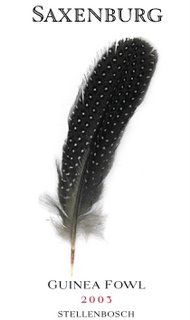
Anyway that blog got me into the whole scene, and from there I discovered a world of wineblogs which led me to Wine Blog Wednesday. If I understand the concept correctly, each month a blogger hosts WBW and gets to choose the subject. Then everyone writes a short blog about the experience on their own blogs, and the results are collated by the host blogger. It's sharing knowledge in a 21st century fashion, it's instant, topical and massively entertaining.
Which brings me to this post. This months topic is whites other than Sauvignon, Chardonnay and Riesling. So the idea is to go out and taste something that fits the brief then write a short tasting note about the wine, post it on your blog then share it with everyone. So here goes.
The wine that i have chosen is Saxenburg's Guinea Fowl White 2005, which is a blend of Chenin Blanc and Viognier from the Stellenbosch. The bottle has a really smart presentation of a long white label with a spotted guinea fowl feather on it.
On the nose its a very aromatic style of wine, tropical fruit with citrus, the viognier comes through with that kind of white peach aroma with a slightly candied edge to it. On the palate there is a hint of fruit sugar pushing the wine towards off dry, its very crisp and clean with vibrant fruity flavours, a slight spritz on the tongue and a lusciously long lingering finish that seems again to have a hint of sweetness about it.
This is a stonking summer quaffing wine, and it goes really well with all sorts of food as well. We had it paired with a mutton dish on a recent gourmet dinner we did with Adrian Buhrer from Saxenburg estate, and it went down a storm.
Well thats my contribution to WBW #20, and I look forward to reading more and hopefully finding a few new things to try.
Subscribe to:
Posts (Atom)